Author: Kamande Wambui

  • The Busy Being Born Live Experience

    The Busy Being Born Live Experience

    By Karanja Ngugi

    (You can find more from Karanja on his incredible Substack, @KaranjaNgugi. It will be worth your while, I promise!)


    Bob Dylan’s Bringing It All Back Home album contributed to the naming of the podcast Busy Being Born, hosted by two brothers, Kamande Wambui and Martin Kigondu.

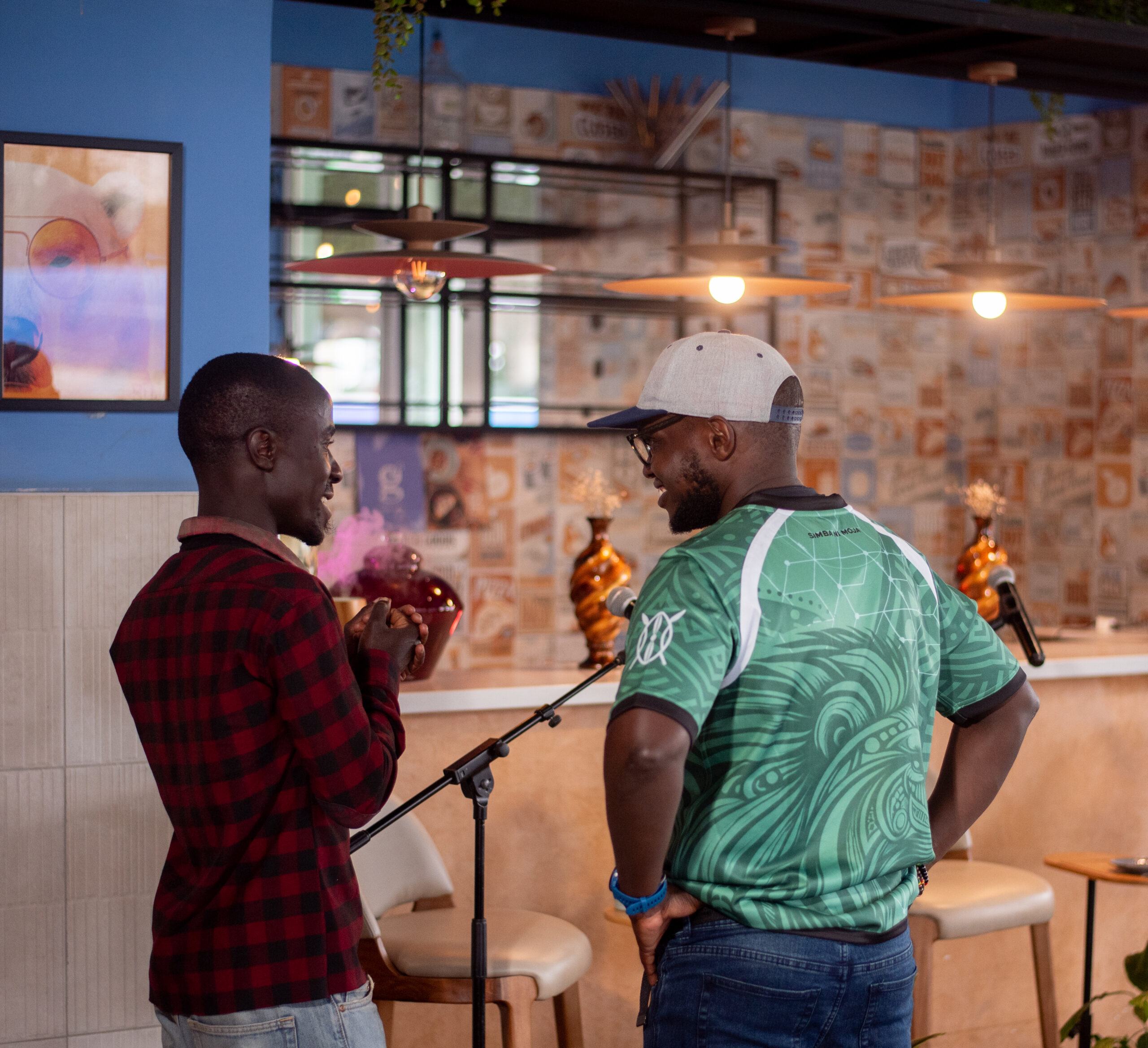
    On this day, 20th June 2026, Busy Being Born Podcast was hosting a live recording episode at Sugar and Lime Restaurant on Mombasa Road. One of the lessons that echoed throughout the event was showing up: for yourself and, in an effort to give back to the community, for others. We showed up, and that’s all that mattered. One of the benefits of arriving at an event early is that you get to see the missile launchers that sound engineers use to launch sound to the event. Launchers often breed chaos, but this time they launched sound that bred good tidings. A good day it was for the nerd in me, learning about machines I didn’t know about.

    We had two segments this day.

    The first segment started with the guest host interviewing the podcast hosts, asking them about the Busy Being Born Podcast.

    “How did the name Busy Being Born come to be?” he asked.

    My mind started running towards answering the question of how one can be busy being born. You can be busy doing lots of things: eating, sleeping aimlessly, doomscrolling, or this classic busy I’m doing now as I wait for either Kamande or Kigondu to answer. As aforementioned, the name of the show came from Bob Dylan and, boom, Busy Being Born Podcast was born. On this day, we were gathered for the second live recording of Busy Being Born Podcast. For those who might try to pull that “Just their second? They have a long way to go…” line, this was their 82nd episode. Most podcasts don’t go past five episodes or, in extreme and not so rare cases, are those podcasts, like my favorite one, The Calgrian, that don’t operate outside our heads. Being Men’s Mental Health Month, the first segment of the show brought us to it, and these were among the questions asked: how the guests’ daily routines were, how they tackle the challenges that come with life in general, how they have been keeping the podcast going for five plus years, you must note that five years is longer than all your relationships combined, and how they deal with emotions like anger.

    The second segment introduced us to a very powerful guest, Dr. Zippy Okoth, an award winning filmmaker and a lecturer at KCA University. She was an embodiment of what joy is like and spoke so joyously on family, self belief, filmmaking, and more.

    To summarize the premises that housed my spirit from both segments:

    Both Kamande and Kigondu echoed the same thing on trusting one’s gut when it came to the pursuit of life.

    “Just DO IT and let it flow.” This was in line with a struggle that had me in a chokehold for a period longer than the two World Wars, and listening to the two reminded me that I am not lost, broken, or devoid of talent. Dr. Zippy specifically spoke of believing in one’s ability to do something. One has nothing to lose but their own chains. It reminded me that all I had to do was trust my ability to do anything. Maybe I’d be married if I just called Lorna, trusting she also speaks nerd like me. I know she doesn’t, but remember…

    Trust.

    Jiamini.

    This premise reminded me that true growth compounds from what we do daily. I had come across this before. They had called it Kaizen. You see, this Kaizen thing had been following me everywhere, and this day was no exception. I don’t know what the Japanese want with me. Must be because of my past life where, if I’m to put it in modern IG lingua, I’d have said, “#Kamikaze4Lyf.” Or, “Just hit a Thai plane. #AviatedThais #Kamikazes.” It spoke to me specifically because I was wondering how we can change this country. Maybe Day 1 should be all about changing its name before Day 2, where we move the capital city from Nairobi to my hometown.

    As you know, men tend to ignore their emotional health, mostly because we don’t know such a thing exists. But since I am among those who are busy being born, I happen to know that a man should have sound and healthy emotional health. Among the things touched on were anger, public display of emotions, and more. The shocking thing I learned is that it’s okay for men to cry. I had never tried it outside the shower, and the reason it hit me hard is because crying outside the shower was blasphemous in my world.

    Dr. Okoth’s story on her childhood was a testament that healthy families do exist. She reminded me of my childhood. Some echoes from the hosts and the audience spoke of how jealous they were of how she grew up. Maybe it’s what Tolstoy said in Anna Karenina: All happy families are alike; each unhappy family is unhappy in its own way..”

    It was a lesson on the importance of community and having a support system. We all need one.

    This day was amazing, and I’ve probably left out a lot.

    Jiamini!

    And remember, “If you’re not busy being born, then you’re busy not living.”

    Live!

  • The afflictive habit pattern of T Minus X

    The afflictive habit pattern of T Minus X

    By Kamande.

    “And how does one place expectations on the future? One gets carried away with the delight of

    ‘In the future I might have such a form’ … ‘In the future I might have such a feeling’ … ‘In the future I might have such a perception’ … ‘In the future I might have such a fabrication’ … ‘In the future I might have such a consciousness.’

    This is called placing expectations on the future.

    For years now, my mind has been running a continuously reinforcing program. I am calling it the afflictive habit of ‘T Minus X’: a relentless countdown to a future moment where I (unconsciously) think true happiness is waiting. It’s a pattern that started in childhood, and it has taken me 35+ years to start seeing it for what it is: a silent thief of my own life and happiness. And maybe this experience resonates with you?

    (I could not wait to publish this! Ha!)

    I went to a decent Boarding School aged 10 (this was the only accessible way my beloved mother could provide access to a good education). As soon as the school term started, the wait also began. The wait for visiting day, when dear mother would bring me all kinds of delicacies and snacks. We had a beautiful tradition of writing letters home a few weeks after opening school, dominated by a list of things we wanted our parents to bring us, and this was a core part of the cycle of waiting. As soon as visiting day was over, the wait for closing day began. We marked calendars and had a reserved corner on the blackboard with the number of ‘days to freedom’. On the penultimate day, we would ecstatically sing Sarafina’s ‘Freedom is coming tomorrow!!’. The wait!

    In High school, the same mindset remained ablaze. This time, waiting for the next out of school event to break out of the boring and mundane day-to-day slug and meet girls; waiting for the mid-term break when we would indulge in all kinds of food, entertainment, teenage love escapades,  and more (redacted because dear mother might read this and I risk my innocent image in her head getting tarnished); waiting for closing day, finishing school and getting out of this damned prison, going to Uni … waiting for freedom to do whatever one wanted to do without supervision – basically, becoming an adult! These precious teenage years were spent with the mind years ahead fantasizing, dreaming, eagerly looking forward to becoming an adult. Oh, how wonderful it would be!

    And then when college came, the all familiar weekly wait for the weekend, starting every Monday morning; waiting for the party, for the football game of the season between Arsenal And Manchester united. I could not wait to be done with these boring and difficult stochastic processes and calculus III classes. But the biggest wait of all, was the wait for employment and financial stability that I was working towards. See, college came with the freedom to do whatever I wanted, but then quickly realized that I did not have the financial muscle to live it out fully. Something as missing. And so I waited zealously, dreaming, for the day when I would graduate, start working and afford the things I could currently not afford, in addition to the freedom. Ah, that would be the day. I looked forward to buying a car with my 5th salary as a fledging statistician (installed with a killer sound system to blast TOK and Agent Sasco music), my own well furnished one bedroom house away from the measly college hostel that I had once dreamt of!

    As you might know or guess, things do not quite pan out that way. Slowly, life unfolded. The tarmacking, the meagre graduate salary that could not buy much those first few years. But the wait continued. I could not wait for the day when I would afford a better house. A better car. And the story continues. Waiting for the vacation. For the party. For marriage to the love of my life. Waiting for kids. Waiting for when my son starts to sleep longer so we can get some rest. Waiting for when he can walk so I can take him to the park. Waiting. Heck, waiting for dinner.

    And the never ending phrase, as we wait, “I cannot wait for thus and thus …”. 

    See, Visiting days came, and went. Freedom came, over and over. Outings, weekends, parties, end of semester exams, more weekends, salaries, kids, dinners, travel … I keep waiting, and they keep coming and going. Everything that I have waited for has come and gone. And I keep waiting.

    This reached its peak for me at the beginning of a recent meditation retreat. I have been doing a Vipassana course as part of my practice every August, and I always look forward to it. This was no exception. I was excited for months about this precious window to continue the work of understanding the mind, and purifying it. And then on day 0 of the course, I immediately started looking forward to day 11, when I would go back home to my beloved family. The course had not even started, but my mind was so accurately operating by the habit pattern conditioned in the 36 years of this lifetime’s existence!

    AHA!

    And then it finally occurred to me, with a non-trivial amount of melancholy, that this habit hasn’t just colored my past; it has been actively stealing the very experience I have longed for for months. Over and over again. My mind is so conditioned to wait for happiness that it cannot accept it even when it has arrived. No sooner have I reached the destination, than I start planning the next departure. Happiness is always in the future.

    Waiting, I have seen, has been such a deceptive robber of the only thing I have, this moment. And so I write this as a reminder for myself, and maybe as a jolt for all of us, to continue the work of waking up to this unfolding moment. This is the heart of what Thich Nhat Hanh calls  “touching the present moment.” To truly arrive in our own lives, we have to stop constantly leaving. And to be clear, this isn’t advocating for a stop to planning for the future, but an invitation to be fully present while we plan, so we don’t sacrifice the reality of this precious moment for the wait or fantasy of a later moment.

    Here is a useful except that serves as a constant reminder for how to practice from the Bhaddekaratta Sutta  (MN 131). May we all be liberated.

    “And how does one place expectations on the future? One gets carried away with the delight of ‘In the future I might have such a form’ … ‘In the future I might have such a feeling’ … ‘In the future I might have such a perception’ … ‘In the future I might have such a fabrication’ … ‘In the future I might have such a consciousness.’ This is called placing expectations on the future.
    “And how does one not place expectations on the future? One does not get carried away with the delight of ‘In the future I might have such a form’ … ‘In the future I might have such a feeling’ … ‘In the future I might have such a perception’ … ‘In the future I might have such a fabrication’ … ‘In the future I might have such a consciousness.’ This is called not placing expectations on the future.

    MN 131
  • 35; Adios Youth, Hello Enlightenment.

    35; Adios Youth, Hello Enlightenment.

    By Kamande

    Kigondu and I turned 35 this weekend, and while he was busy on stage performing the magnificent Lwanda Otero, I was wrapping up a meditation retreat. We are grateful for yet another year to make progress and to stay busy being born! Turning 35 is especially interesting for two reasons, it occurred to me: 

    1. In Kenya, reaching 35 officially means we’re no longer considered YOUTH. Goodbye, Youth Fund! 

    2. Gautama the Buddha attained full enlightenment at 35! Here we come, FULL LIBERATION!


    Over the years, I’ve kept a collection of quotes and lessons I’ve come across in both digital note apps and books. I thought I’d share 35 that I keep returning to on my journey as reminders. These aren’t original, but I’ve paraphrased and added some commentary over time as I revisit and apply them in my practice and life.

      1. It’s okay to be lost sometimes, but we should train ourselves to be aware that we are lost, and not panic. It is only in being lost that we are found.
      2. Everything can be taken away, apart from the liberty of how you react. This also extends to control – you will always have control over nothing, apart from your response to stimuli. It, however, does not absolve us from responsibility for things you have no control over. Life.
      3. I share a birthday with Marcus Garvey – you are twice defeated in the battle of life if you have no confidence in self.
      4. We are entirely responsible for how we feel – no one and nothing makes us feel anything. Happiness and misery, thus, are all internal.
      5. No matter how much we love and want the best for others, we can only show them the path and walk alongside them. They have to save themselves; we can only liberate ourselves.
      6. Part of life is balancing the awareness of your cosmic insignificance with your immense importance at a local level. The former builds humility and freedom; the latter drives responsibility and purpose. Nothing, and everything.
      7. Being Busy is a modern-day myth that we tell ourselves, limiting how much we can do for the world around us.
      8. Community is very important, especially in this part of the world. Be part of one. Do not walk alone. But also, you would rather walk alone, than with bad company.
      9. Do the next thing as impeccably as if it will stand the test of time.
      10. Without health, at any stage of your life, you have very little if anything to work with, if anything at all. Health, then, should be a priority, especially along the variables/levers that you have control over.
      11. There is nothing on the other side of fear. We suffer more in our imagination and conceptualization than in reality.
      12. Paraphrasing Feynman – Fall in love with an endeavor and explore it deeply. Nobody ever figures out what life’s all about, and it doesn’t matter, anyway.
      13. Dying men think of funny things – and that is just what we all are, dying men.
      14. If I am, death is not. if death is, I am not. Why should I fear that which cannot exist when I do?
      15. Growth is driven by compounding, which always takes time. Destruction is driven by single points of failure, which can happen in seconds, and loss of confidence, which can happen in an instant.
      16. With persistence, success can come at any time. However, the persistence and effort have to be balanced by wisdom, so that we are efforting/persisting in the right direction
      17. Conservative in our behavior, liberal in our tolerance.
      18. Your best theories are going to be creative guesses, not simple extrapolations.
      19. Compassion is a VERB. Give. Help. Uplift. Devoid of expectations.
      20. Once we realize that all our love is selfish, we can start removing the attachment from our love, which continuously reduces our capacity to love purely.
      21. Life is only perception.
      22. We see people and things not as they are, but as we are.
      23. If it is endurable, endure it.
      24. One moment of kindness is greater than a hundred years of ordinary life. One moment of perfect attention is greater than a hundred years of kindness.
      25. This is where you’re supposed to be. Marcus Aurelius. “Vile meli inaenda ni kama ndivyo ilifaa kwenda, na kama sivyo, basi meli ingezama.” Nyashinski.
      26. Inaction breeds doubt and fear. Action breeds confidence and courage. If you want to conquer the negative elements in our life, we don’t sit at home and think about it. We go out and get busy!
      27. Teach the children to be competent, moral and compassionate.
      28. Resist even the slightest urge to be cynical.
      29. At the apex of pain, we find success.
      30. Everything that we have feared or looked forward to has come and passed. Is there anything to fear or to look forward to?
      31. The end of meeting is dispersion – we are all in a market, and before long, each of us heads home. 
      32. Love your crooked neighbor with all your crooked heart.
      33. Treat everyone you meet as an old friend. EVERYONE.
      34. In the end, what matters will be how much we have developed our love and purity. “We cannot claim victory until our hearts and minds are pure.” Jah9 / Chronixx.
      35. Impermanence is our only inheritance. EVERYTHING changes. It is all in the process of becoming otherwise. Let go.

    May we all generate pure love.

    Ps. I’ve been listening (Youtube) to Jack Kornfield and the Grandfather of gratitude, Brother David Steindl-Rast, delve into sacred reflections on death, where Buddha meets Jesus, the power of compassion, the positive side of grief, and beyond. It’s been so nourishing. Brother David’s chanting of Salve Regina at the end has such loving-kindness vibrations.

  • True peace is only here, now

    True peace is only here, now

    By Kamande.

    The constant hum of worry, a familiar tune, threatening to drown out the melody of life.

    A good part of my disposition has been worrying, and doing so with such potency that it is borderline debilitating. The constant hum of worry, a familiar tune, threatening to drown out the melody of life. This realization and acceptance a few years back is partly how I came to the teachings from the East. The general trend since then has been a positive one, I would say, but not because the worrying has significantly reduced. No, it is simply because I have gradually learnt how to notice it, even at the most subtle level. And with that, I am learning how to embrace it like a baby. To cradle it with tenderness, and to not be entangled in its grip to the extent that I identify with it. Note, I say trend, because there are substantial random and seasonal peaks and troughs along the way.

    See, even when every external thing around me is seemingly going well, this little baby of mine will not go to sleep. In fact, that is when the screams go an octave higher. That is when, putting it simply, the thoughts of a gloomy near, medium or long term future (pick your flavor of the hour/day) multiply in orders of magnitude. The bodily sensations are so gross, in the form of almost audible heart palpitations and a really heavy and contracted chest. Sensations, really, are the manifestation of valence.

    Here is the comical bit, very few of the things (if any) I have worried about and allowed to intrude into my mind for extended periods of time have happened. (And even when they happened, where are they now?). 99% of the time for me, it is not the useful kind of fear that prepares us to take skillful action and reduce harm, but the kind that makes us see a cobra where a piece of rope has cast its shadow. 

    There are countless teachings that help us understand this and practices that can lead us down the path of less, and eventually no, suffering. One resonates intensely and has occupied my mind a lot while providing moments of peace – the deep realization that true peace resides solely in the here and now. Worry, and especially the afflicting identification with it, is predicated and thrives if and only if we lose touch with the present moment. The things I worry about are never happening now, but in an imagined future that is out of reach in the present. By returning to this moment, which is all there is, I become the one who knows and let things happen exactly as they should. The little baby that is my worry wails, but I do not become the worry. The constrictions happen, but that is yet another experience that is left to rise and fall without interference. In this space, glimpses of an open heart-mind emerge, free from aversion. Albeit momentarily.

    Simple as it sounds, realizing sustained awareness and mindfulness of this moment with equanimity and wisdom, is like swimming upstream. Fighting a thousand soldiers a thousand times. But many have swam and continue to swim. We share the same intrinsic ability, and so we diligently practice with the confidence that we can similarly arrive at the sustained peace and happiness of now. May our hearts be at ease.

  • The Seduction of Anger

    The Seduction of Anger

    By Kamande. Image by Conrad Whitaker.

    Anger, with its poisoned root and honeyed tip.

    Anger is an emotion that mostly comes from the feeling of being right and others being wrong. It is clearly borne out of wanting things to be different than they are/were.

    I cannot say that I have had to deal with significant anger issues in my life. It is however an emotion that arises quite often and the results are not elegant, to put it mildly.  Most times, I have walked with it without paying attention to it, caught up in it,  for a period of time before it evaporates. Other times, I mindfully pay attention and hold it with compassion, and it dissipates. This is the nature of emotions.

    However, at other times, I get caught up in a vicious cycle of thoughts trying to justify its arising, which creates a lump in my chest. I ask myself,  ‘How could they do that? How could they see things that way? How could they say that? How can they not see how wrong they are? How can they not see how right I am? How can they keep doing that?’. And the story goes on and on. This thought-emotion spiral can either naturally wither or be dissolved by mindfulness and compassion.

    At times, I have acted it out. The feeling of being on the right is so strong that in a split second the skillful means for taking care of the emotion is overwhelmed. The result is wrong thought followed by wrong action and/or speech. Everything collapses, and before I know it, I have made harmful speech, or harmfully acted. It is a recent experience that prompted a deeper look into anger and this post.

    Earlier this year, on my way to work, a fellow driver was overlapping. I was in what I thought was the right lane, and had slowly gotten to the turning, only for this driver  to come from the outer lane and try to ‘cut me off’ heading into the turning. How could they do that? I, and the other drivers, had obeyed the rules and used the correct lane patiently, only for him to use the wrong lane and not line up like everyone else! The story quickly became intense and  powerful, the more I got caught up in it. The anger was overflowing now. Road rage. I had to stop this disrespectful driver. How could I not? He was everything wrong with our society. As I tried to maneuver and stop him from cutting me and the rest of the law-abiding drivers off, I reversed into the car behind me. A brown BMW SUV. Long story short, acting the anger out cost me Kes 10,000 at about 7:54 AM! (The owner of the car I hit treated me graciously, and the resolution was quite amicable. How lucky! At that point, I felt that I deserved all repercussions, and had braced myself for the worst!)

    In all forms of aversion the heart contracts. We then become imprisoned by our own mind’s reactions and subsequently solidify a sense of self and separation. But there is also something extremely seductive about anger that keeps pulling us in and feeding it. The Buddha described it well when he said, “Anger, with its poisoned root and honeyed tip.” We feel empowered, energetic and often self-righteous when we’re lost in angry feelings.

    See, anger seems to have this promise of joy the more we wrap it round the self. But this does not hold up to any wise scrutiny. It is just that, a false promise. The poisoned root is similar – it is a reinforcement of this false sense of separation, stemming from ‘I am right’ and ‘THEY are wrong’.

    There are many teachings on working with emotions such as anger and fear, both converging to the idea of shining compassion to them and not getting caught up in the whole story. One approach that has been very helpful is taking away the ownership of these emotions. This subtle change in language from  ‘I am angry/afraid etc’ to ‘there is anger/fear’ stops the I/Mine/self view train before it even leaves the station. The seduction of anger, in particular, then has no subject. There is just an energy, a sensation that can be held with compassion, as a challenge, and it disappears. While not easy, this simple reframing can be incredibly powerful. I have since started playing around with it, and found it to be effective, especially when combined with other practices such as mindful breathing and the view of impermanence. As a side note, anger can also be an energy for action/activism against oppression, but without wisdom, the slope gets very slippery. So maybe compassion is a better energy?

    Anger is like a howling baby, suffering and crying. The baby needs his mother to embrace him. You are the mother for your baby, your anger. The moment you begin to practice breathing mindfully in and out, you have the energy of a mother, to cradle and embrace the baby. Just embracing your anger, just breathing in and breathing out, that is good enough. The baby will feel relief right away. All

    ― Thich Nhat Hanh, Anger

    All said and done, it is easy to be patient when no one is bothering us. The patience required in dealing with this strong emotion requires us to have the willingness to put in the required effort. May we all create the conditions for wisdom and happiness.

  • 3 Years a Father

    3 Years a Father

    “We are all just walking each other home.”  – Ram Dass.

    Is there anyone we are privileged to closely walk home, more than our offspring? True as that might be, we end up being the ones who are walked home by them if we allow ourselves to, metaphorically through our lifetime. It is the same with learning. I became a father three years ago, confidently knowing that I was getting a chance to teach and mold. Kamande the potter. How stupid. How egotistical. I still feel the same way, by default, but I am more aware of the fact that the inverse is happening. Do not get me wrong, it is still a parent’s responsibility to nurture, educate, correct, but it is not as one way of a street as I always narrowly imagined. I am tempted to put it into probabilities, but it is hard to measure. And we need not always try to be empirical with philosophy, ama?

    You see, beyond learning how limitless the well of love runs, our children teach us every passing minute we are with them, if we pay attention. I like to think of an examined life as a journey towards our inner child; towards the biblical garden of eden before man’s fall from grace. “Let the children come to me”, Jesus said. There is nothing at the end of that journey, but the practices that get us there help us get close to the bone of life. If we assume that is true, then what better way to map that journey than by learning from the children themselves?

    My son (And Kigondu’s godson) turned 3 years old in March. Kigondu and I turn 33 Years old in August. There might be nothing to it, but there is a numerical pattern that is evident here with our DoEs (Days on earth).  And so, I thought I would document 3 things my son has taught me / practically reinforced over the 3 year journey, at 33. It is also a documentation of the lessons, as I immerse myself into bringing up the second offspring.

    “Got it. Lost it. Every moment. Over and over again.”

    Allan Watts

    Participation without attachment

    This is, perhaps, one of the toughest things to do, given our human proclivity to base all material and immaterial relationships on attachment. Even love. In his book, Awareness, Fr. Anthony DeMello says that attachment reduces our capacity to love. Integration of this into our lives, for all the great things it yields, is hard. However, I have seen my son fully indulge in an activity, and then move on to another a few minutes later. What is astounding is that you can see the transition to the next thing with zero attachment to the preceding thing. You might argue that his prefrontal cortex is not fully formed, for another 22 years, but by god, what a joy it is, for him to fully detach and move about life while fully participating in the present! He is neither plagued by the past, nor pre-occupied by the future. Is that not the theoretical antidote to depression and anxiety? And overall, Dukkha?

    The same happens with his emotions. He does not postpone feeling them, whether they are positive or negative. He cries or laughs his heart out with no attempt to feign strength (WTH is that, anyway?), and then moves on. In addition, he does not allow those feelings, especially the negative ones, to become a mood. In fact, it is my wife and I who refuse to move on in a bid to teach him a lesson, in the many events when we say no to something he really wanted but we know from our experience is not good for him, or when he is being naughty.

    We can be more patient than we imagine

    “And don’t you live life in a rush

    The past cannot be returned to

    And when you feel like giving up

    Remember patience is a virtue ..”  – Damian Marley. Stony Hill. So a child may follow. 2017.

    I cannot say that I was overly impatient but whatever level of patience I had, has been tested more than ever before since I became a father. I think all parents can attest to this. I remember early on, at 3:43 AM, wondering if this is how the next few years would be. And then wondering the same thing at 4:24 AM, when we thought he was finally asleep only to hear him whimper and build up to a now dreaded crescendo. At that time of the night, when you have tried everything in the book to get them to sleep so you can catch an ounce of sleep yourself to function better at work the next day, the upsides of this parenting journey are maybe harder to appreciate – unless you have trained yourself to do so. It is easier to react, and overriding this behavior is something I have had to train myself to do. I will not say that I have mastered it, but here are somethings I wrote down as reminders to fortify my patience:

    • They are not doing this to spite you. It is not malicious.
    • It is your duty. You chose it [or not], and you are here now. Do it. “Don’t be overheard complaining…even to yourself” (Marcus Aurelius)
    • You have had and will hopefully have many more nights of uninterrupted sleep. This is temporal.
    • Use this as a training ground for patience with everything else – if you can do this patiently, then you can be patient with most things in life!
    • You are not the first to be going through whatever difficulties you’re currently facing, nor will you be the last.
    • It is your duty!

    The reps from those nights and the self talk, have gone a long way in building patience in other scenarios that require it even more in parenting. From the proverbial terrible-two unpredictable phase in development, to breaking down why some things have to be one way and not another sometimes [Baba has to get on this call – we will resume playing later. You cannot continue watching Peppa Pig because it’s nap time. Mama has to go to work. You cannot have chewing gum at 7:08 AM.]

    Every moment is special. Be here, now.

    ‘If it can happen to anyone, it can happen to you.’

    Got it. Lost it. Every moment. Over and over again. That is life. And yet, we remain uncertain of getting the next moment. As Seneca writes, “Moments are torn from us. The whole future lies in uncertainty.”. Somewhere at the back of my mind, this always reverberates – maybe it does for all of us, because we say it casually during conversations; or when someone we know dies. 

    “Life ni fupi!”

    “Eh. Sana”

    “Noma, buda!”

    But now, it is a practical reminder to cherish every moment, especially with my son. This is not an entirely selfless endeavor, but it is also driven by (and can yield more) loving awareness. It is a source of joy for me, irrespective of the circumstances, and he also seems to revel so much in every moment we are together, and that compounds the joy for me. He is so deeply immersed in our play, as if it were his last. That is what children do. They are naturally enlightened, until the world changes that. On my part, I am aware that this could well be our last interaction, and I want it to be filled with loving awareness, in case it is the last; and I got it then lost it. I might not get the next one, but I sure hope I do – For THEM.

  • Why the hell am I even doing this?

    Why the hell am I even doing this?

    I am not sure how many of us question our decisions, despite having made them logically and having extensively, if not exhaustively, evaluated the risks and benefits. I can speak for myself. The questioning comes in two doses. The first is frequently worrying about the future value of the decisions. The second is periodically, and deeply, wondering why the hell I am doing whatever it is – are the reasons intrinsic, or extrinsic? Meaningful or stemming from the need to elevate a self? Does it bear any usefulness for the community?

    Warren Buffet, someone I have learnt one or two things from, in his 2022 annual letter to the Shareholders of Berkshire Hathaway Inc., says, “Teaching, like writing, has helped me develop and clarify my own thoughts. Charlie calls this phenomenon the orangutan effect: if you sit down with an orangutan and carefully explain to it one of your cherished ideas, you may leave behind a puzzled primate, but will yourself exit thinking more clearly.”. My Data Science career has profoundly benefited from teaching. I have grabbed almost every chance to teach because of how much I learn and understand the concepts. Part of my plans is to soon attempt to explain statistics theorems and corollaries and machine learning to my 3 year old, and see how well I actually understand them. Anyone who opens up to a conversation with me knows how much I, annoyingly maybe, attempt to talk through various philosophical ideas to get clarity and congruence in my thinking. I have rarely, if ever, done so in writing, in spite of my awareness of the usefulness. This is my attempt to change that.

    I have continuously examined my reasons for building the Busy Being Born podcast, but I have not documented them. We have spoken about them, in passing, in some of our episodes, but the details are mostly in my head. Maybe after writing this, I will realize the inconsistency and incoherence in my reasoning, and choose to let it go. Ha.

    I was captivated by learning through conversations in 2016, when (thanks to my good friend Sam Floy, whose ideas and personality I felt incredibly drawn to) I discovered Tim Ferriss. I will go as far as saying that I was finding my way back after a few years of letting go and living in quite an unexamined way. I was not living badly and my default setting was not immediately fatal but it had been and would continue to be a gradual path to unideal results, starting off with physical health, if I did not change course. I was looking in many places for material and concrete self-help and Tim’s podcast and books were the beginning of the rest of my life. I read and re-read the 4 Hour Body and got inspired every day by the world class performers on the show.

    “If you’re not embarrassed by the first version of your product, you’ve launched too late.”

    Reid Hoffman

    Beyond the changes I continued to make in my life and regaining more control of my personal trajectory, two things happened:

    1. I became acutely aware of the missing context in this particular self-help genre.
    2. Naturally, I was excited to share the lessons of this new found framing and get more people on board. I now like to blatantly think of the people who I choose to influence my thinking as cult figures. And what does a cult member do? They preach and preach, in a bid to make anyone and everyone a convert!

    And thus, the Prime Your State Podcast was born. I bought a Microphone and a stand from Amazon and armed with my simple gear and self taught recording and audio editing software, set off to talk to young Kenyans I reckoned Africa would learn from.  How do they prime their states for performance? Three episodes. Kaput. And like 95% of podcasts started, it was in the graveyard! Sound quality perhaps cringe worthy but the content, not so much! I was proud of what I was setting up nonetheless, even though in hindsight, I find it a bit embarrassing. I also found solace in Reid Hoffman’s advice on building products: ‘If you’re not embarrassed by the first version of your product, you’ve launched too late.’

    PYS might not have gone far, but I continued to feel the itch, mostly from the first challenge above. I continued to listen to more Time Ferriss, and would go on to discover other phenomenal long form interviewers and eventually personal cult (Ha) leaders (Peter Attia, Guy Raz, Naval , Tyler Cowen etc) whose ideas, guests and conversations challenged and educated me, but the context continued/s to be missing. Of all the identities that this self has, African is up there, and the difference in context is not trivial when consuming and applying individual and community improvement strategies and tactics. The political, socio-economic, cultural setting is different, and that plays a fundamental role. Context is everything.

    Kigondu and I have come a long way, moving from discussing our dating escapades for hours in our early 20s, to discussing philosophy and self improvement in our mid to late 20s. Maybe I planted the Podcast idea into Kigondu’s head, because that itch was still there. That and maybe, it was just meant to be. I was just sparking the natural movement towards this thing. Two is better than one. Kidole kimoja hakivunji chawa! It is very different from building PYS by myself, because Kigondu brings in enormous creative talent and energy, in addition to his networks in the creative industry that brought us to the studio where it all happens, run by a gem of a human being and creative. 27 Episodes in, and it still feels like day 1. Still, I get overflowing joy when Abu, the producer/sound guy/solid brother, cues us in. I am still learning, and enjoying the conversations with every guest. I am still laughing a lot in between the stories of busy being born. That is important to me – because we are all dying men. And dying men ought to laugh at every opportunity.

    Beyond the delight I get from doing this, the present value for Kigondu and I and for our ~100 odd listeners, and the future value I believe it has, if not for anyone else, my offspring, it just happens that doing this is one of those near effortless tasks. Do not get me wrong, it is WORK; from booking guests to doing research on them, from finding mutually convenient time slots for the three involved parties to making the interviewees as comfortable as possible and so on. It however does not feel like work for me, especially when we get to the core of this – the conversation itself. I do not know how big of a part I have to play in that, but it has been the accumulation of some deliberate and unconscious reps, stacked on nature’s providence. It feels quite natural, and if I could frame it within the Ikigai framework, then this is a passion and mission. And maybe, just maybe, we can find our way to the center. If it does not happen, then that is what nature has allotted, and I will accept it. Reverence.

    Stay busy being born!